

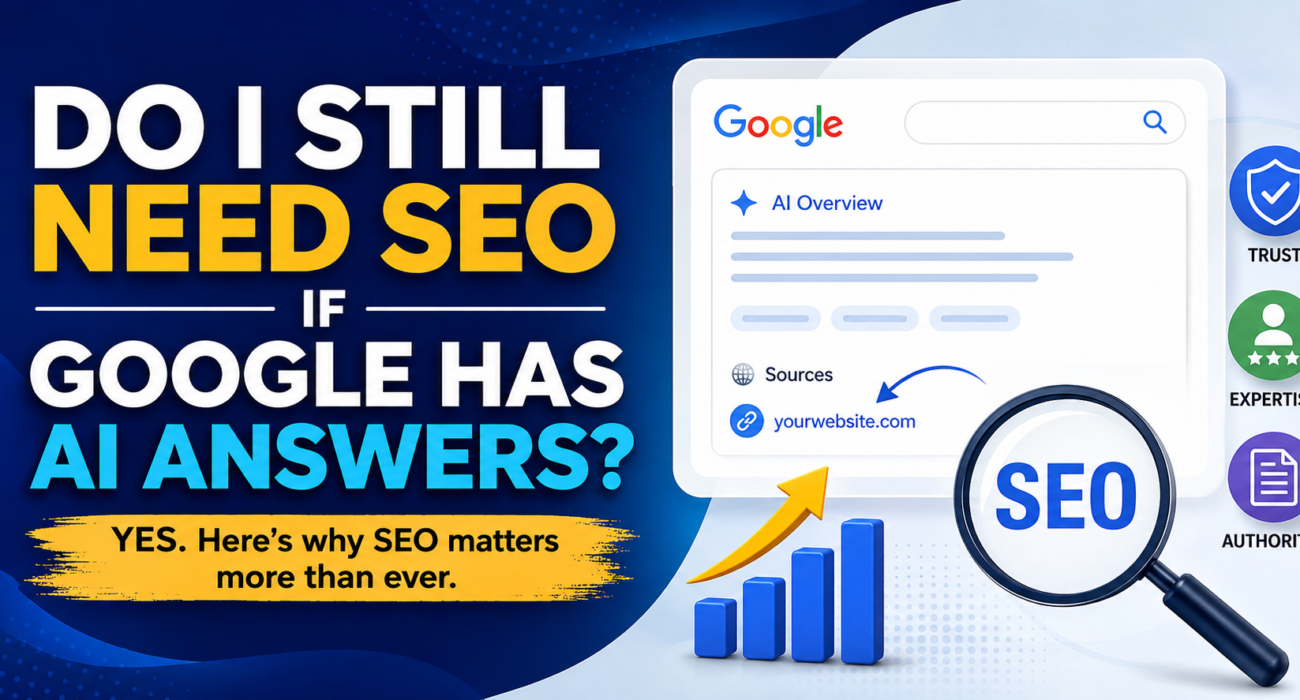
Walk into any business forum or scroll through your social feed, and you will see the exact same panic: “Google is rolling out AI overviews for everything. Chatbots are answering users’ questions directly on the results page. Is anyone actually going to click on a website link ever again?”
It is a completely valid question. When Google places a neat, paragraph-long AI summary right at the very top of the screen, it feels like the traditional list of blue website links has been pushed out of sight. For business owners and creators who rely on search engine optimization to get clients, this shift looks like an existential threat.
But let’s look past the scary headlines and address the core reality. Do you still need SEO if Google has AI answers? The definitive answer is yes—but the way you do SEO has changed forever.
AI answers do not appear out of thin air. They do not possess original thoughts, and they cannot run experiments or invent new concepts. Google’s AI is essentially a massive, highly advanced summarization machine. To give an answer, it must crawl the web, find reliable data, and pull information from real, human-generated websites.
If your website is not optimized for search engines to read, categorize, and trust, Google’s AI will never find your content, let alone cite it as a source. Far from making SEO obsolete, the rise of AI answers has made high-quality optimization more critical than it has ever been.
Why AI Overviews Can’t Replace Traditional Search
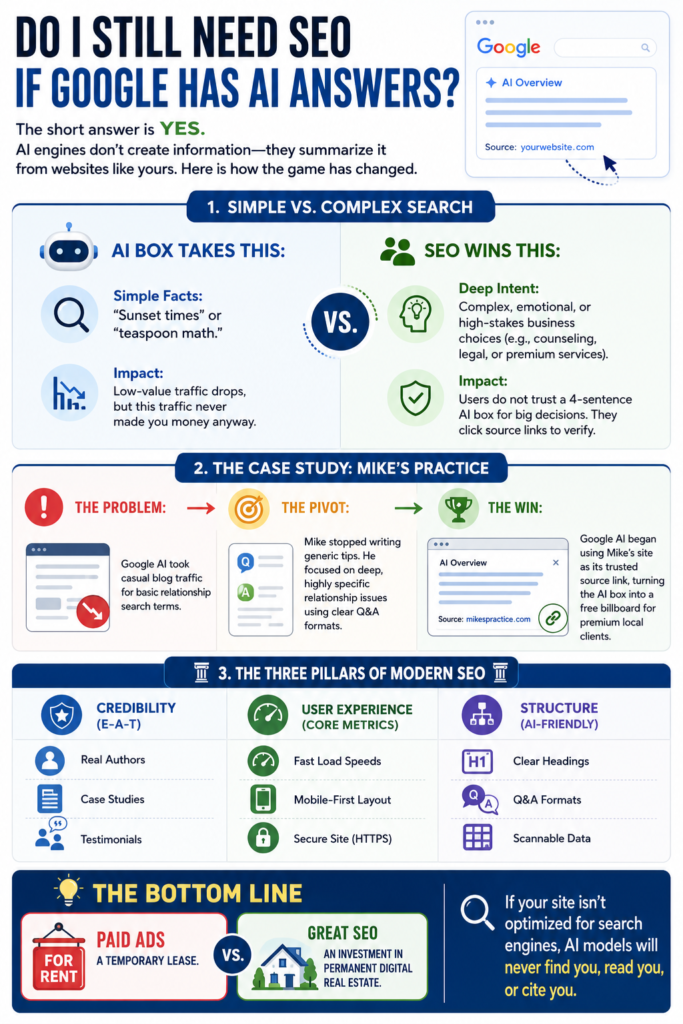
To understand why your website still needs SEO, you have to look at how people actually use the internet. AI overviews are fantastic for simple, transactional, or quick factual questions. If someone types “What time does the sun set in Bangkok today?” or “How many teaspoons are in a tablespoon?”, an AI summary handles it perfectly. The user gets their answer and leaves.
To be completely honest, those types of quick-fact searches never drove valuable commercial traffic to businesses anyway.
However, when users have complex, high-stakes, or highly personal inquiries, an AI snapshot is rarely enough. People do not make major life decisions, buy expensive services, or solve deep emotional problems based on a anonymous four-sentence AI summary. They want depth, human perspective, and credible authority.
The Trust Deficit
AI models are notorious for “hallucinating”—making up facts that sound entirely plausible but are completely wrong. Because users are becoming increasingly aware of this limitation, they treat AI answers as a starting point, not the final word. When a user sees a summary, they naturally look for the source links embedded within or below the AI box to verify the information.
The Need for Human Connection
An AI can list the generic symptoms of burnout or outline the technical steps of a legal contract. But what it can’t do is tell a real-world story, or offer authentic empathy, or give a nuanced opinion based on years of professional practice.
Case Study: How Mike’s Relationship Therapy Practice Thrived in the Age of AI
To illustrate this dynamic, let’s look at a real-life scenario with Mike, a licensed relationship therapist who has a private couples counseling practice.
Mike noted a short-term dip in casual blog traffic after Google rolled out prominent AI overviews for mental health and relationship questions. Queries such as ‘signs of a communication breakdown’ began to produce instant AI lists on the search page. Mike was beginning to think his efforts in digital marketing were being wasted.
Mike didn’t quit, instead he changed his SEO strategy to be heavily focused on search intent, deep human experience and local authority.
What Mike Did:
-
High Intent Targeted Complex Questions: Mike started writing in-depth resources on complex emotional situations like “How to rebuild emotional safety in a marriage after a major breach of trust” instead of writing generic articles like “5 Tips to Stop Fighting.”
-
Showed Real Expertise: He set up his articles in easy-to-digest, answer-based formats that Google’s AI engines could easily parse, but he filled the text with real-world, anonymized examples from his years of counseling practice.
-
Citation-Friendly: He used clean formatting, punchy bullet points and authoritative definitions.
What Happened:
Google’s AI engine began feeding definitions from Mike’s site directly into its relationship summaries, since his content was so well organized and had obvious professional credentials.
More importantly, when couples in his city searched for highly sensitive queries, the AI overview would display a brief summary and prominently feature Mike’s website as the primary trusted reference link.
Users reading the AI summary clicked through to Mike’s site because they wanted to read the full, empathetic breakdown written by a real human professional. By aligning his site with modern SEO standards, Mike didn’t just survive the AI shift—he used the AI box as a premium billboard that drove highly qualified local clients straight to his booking page.
The New Pillars of SEO in the Era of AI
If you want your business to replicate Mike’s success, you have to abandon old, robotic SEO playbooks. The game isn’t about using a certain keyword twelve times in an article anymore, or trying to fool an algorithm. Your optimization must be a holistic approach to the user experience to rank well and be cited by AI models.
Modern SEO Architecture
-
Expertise (E-A-T): Real Author, Case Studies, Deep Insight
-
User Experience (Core Web Vitals): Fast Load Speeds, Mobile Optimization, Secure Site (HTTPS)
-
Structure (AI-Friendly): Clear Headings, Q&A Formats, Schema Data
1. Radical Credibility (E-A-T)
Google places a lot of emphasis on Expertise, Authoritativeness and Trustworthiness (E-A-T), especially for topics that impact a user’s health, finances or long-term happiness. To remain relevant, your website has to show it’s run by a real person with real credentials.
This means creating dedicated author pages, citing reliable sources, keeping information updated, and displaying authentic customer testimonials.
2. Impeccable User Experience
An AI might scrape your text, but human visitors still have to interact with your physical website. If a user clicks an AI citation link and lands on a page that takes five seconds to load, has pop-up ads blocking the text, or shifts around wildly on a mobile screen, they will hit the “back” button instantly.
Google tracks these negative user experiences and will quickly strip your site of both its traditional rankings and its AI citations. Your site must be fast, secure, and completely frictionless to navigate.
3. Clean, Question-Answer Structure
AI models are built to answer questions. If you want these models to use your content, you need to write content that speaks their language. Organizing your pages with clear headers (## and ###) that mirror the exact questions your clients ask is a vital tactic. Follow those headers with direct, concise, answer-based sentences before diving into deeper analysis.
Sustainable Growth vs. Paid Shortcuts
It is tempting to think that if organic search is changing, you should just shift your entire budget into paid digital advertisements. While paid ads definitely have a place in a balanced marketing strategy, relying on them exclusively is an incredibly expensive trap.
The moment you stop pouring money into an advertising campaign, your visibility drops to absolute zero. Paid traffic is a temporary lease; SEO is an investment in digital real estate.
When you optimize your website correctly, you are building a long-term asset. A well-written, deeply helpful resource page can continue to rank at the top of search results and get featured in AI overviews for years, bringing a steady stream of highly qualified customers to your door without requiring an ongoing per-click fee.
Frequently Asked Questions (FAQs)
Does SEO still matter with AI?
Yes, SEO matters now more than ever. Google’s AI answers do not generate original information; they pull their facts, data, and recommendations directly from indexed web pages. If your website is not properly optimized for search engines, the AI will not be able to find, read, or cite your content in its summaries. SEO is simply shifting from ranking a list of links to optimizing your site to be the trusted source that feeds the AI.
Does Google SEO punish AI content?
Does Google penalize content because it was created by artificial intelligence? Not at all. And Google’s own guidelines say they reward high-quality content that adds real value to users, no matter how it was created. However, if you use AI to generate a large number of low-quality, repetitive or inaccurate articles just to game the search rankings, your site will be penalized as spam. Focus always on quality, accuracy and human oversight.
Is SEO dead or changing in 2026?
SEO isn’t dead, it’s changing dramatically. The days of exact-match keywords and basic backlink searches are gone. In 2026, SEO is about user intent, direct answers, deep technical performance (fast page speeds), and verified author authority. Instead of just trying to rank number one for one phrase, businesses are optimizing their content to be comprehensive topical authorities so they rank in traditional results, voice searches and AI overviews alike.
Does AI increase SEO?
Used properly, AI tools can dramatically improve your SEO performance. AI software is good at analyzing the huge search patterns, finding missing topics in your articles, structuring data and making clean outlines. However, simply copying and pasting AI raw text without human editing, unique insights or personal expertise will not help your rankings. AI can be a powerful assistant for optimization, but it is not a substitute for original thought.
Is Google AI hurting SEO?
Google’s AI features are shifting the way traffic moves, which can reduce clicks for simple, factual keywords that are easily answered directly on the search page. However, it is helping SEO by sending highly targeted, ready-to-buy users to websites that are cited in complex queries. Rather than destroying traffic, AI is filtering out casual browsers and rewarding authoritative sites with visitors who have deep search intent.
What is the 80/20 rule of SEO?
The 80/20 rule (or the Pareto Principle) in SEO states that roughly 80% of your organic search traffic and business conversions come from 20% of your content. This means you do not need thousands of chaotic blog posts to succeed. Instead, focus your energy on creating a handful of incredibly thorough, perfectly optimized, high-utility pages that target the specific, high-intent questions your ideal clients are asking.
Is SEO a dying industry?
No, SEO is a thriving, expanding industry that is becoming more technical and strategic. As long as humans need to search for products, services, and medical or emotional advice, there will be a need for businesses to optimize their digital presence. The industry is changing out of necessity, forcing professionals to move away from simple copywriting and move toward comprehensive digital brand authority and platform-wide optimization.
What are the 4 pillars of SEO?
A successful SEO strategy consists of four core pillars:
-
Technical SEO: Making sure search engine bots can easily crawl and index your site – including fast load speeds, secure HTTPS connections, and mobile-first responsive design.
-
On-Page SEO: Creation of quality content, written clearly and answer-based, with the proper use of headings, keywords, and clear intent.
-
Off-Page SEO: This is improving the reputation, digital footprint and authority of your website, through high quality backlinks, brand mentions and social signals.
-
Local SEO: Fine-tuning your business profile, location data and customer reviews to tap into geographic-specific searches in your vicinity.
Is AI better than SEO?
This is a bit like comparing an engine to a map—they serve completely different purposes. AI is a tool used to process, summarize, and generate information. SEO is the strategic practice of organizing your digital information so that both human users and AI engines can find and trust it. You do not choose between AI or SEO; you use AI technology to enhance your workflow so your website achieves superior SEO results.
What will be the salary of SEO in 2026?
Your SEO salary in 2026 depends on your experience, location, and technical skills.
Starting out as a junior specialist or content writer, you can expect to make around $55,000 to $75,000 per year.
If you are an experienced manager, a technical pro, or a consultant who knows how to make websites play nice with new AI search engines, that pay jumps up to anywhere between $95,000 and $140,000+ per year.
And if you run your own agency or work as a top-tier freelancer, you can make even more by proving your results directly boost a client’s bottom line.